e.l.f. Halo Glow vs Charlotte Tilbury Flawless Filter: the honest comparison
At $14 against $44, e.l.f. Halo Glow positions itself as the ultimate dupe. We tested them side by side — here's what really differs.
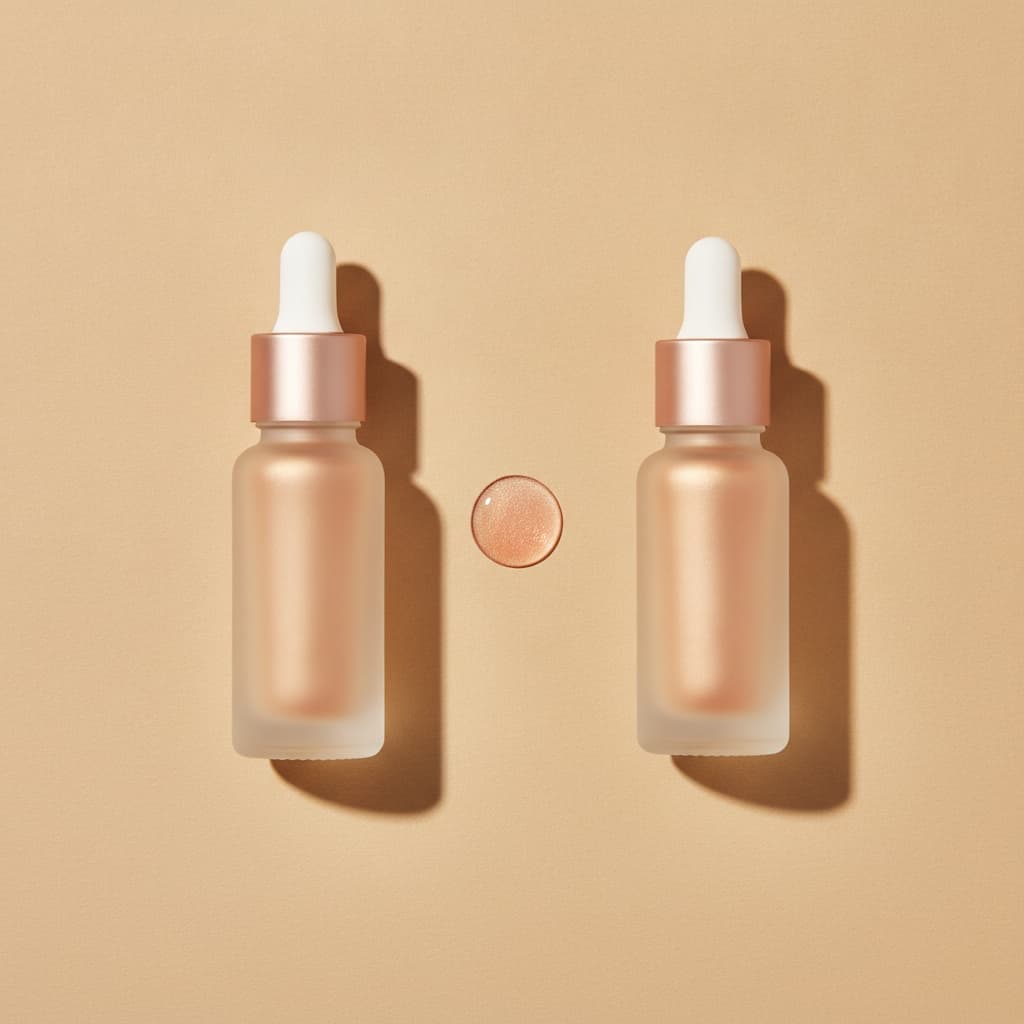
Start with the e.l.f. Halo Glow, about $14: for everyday wear, the value is unbeatable. The $44 Charlotte Tilbury is only worth it if you want the pure soft-focus finish with no shimmer at all.
Charlotte Tilbury's Flawless Filter is the liquid illuminator that defined the 2020s — the product makeup artists pat onto stars' skin before the red carpet. The promise: an "IRL filter" finish, luminous soft-focus skin without looking made up. The catch: $44 a bottle. Four years later, e.l.f. drops the Halo Glow at $14 and asks: does it really do the same thing? We compared the two, formula against formula, finish against finish.
Identical promise, different formula
Both products aim for the same result: a light-diffusing complexion with a soft glow that's visible without shouting. But their chemistry diverges. Charlotte Tilbury relies on a "Light Flex Technology" complex (micro-spheres that blur irregularities). e.l.f. Halo Glow uses micro-flakes of mica and talc that reflect light more directly. The consequence: CT delivers a more diffuse effect, e.l.f. a more visibly glowy one.
“A dupe is never a copy. It's an interpretation at another price point.”
The test under normal conditions
Applied alone on hydrated skin, both visibly blur pores and add radiance — but not exactly the same. Charlotte Tilbury stays more subtle, more "skin-like," nearly invisible yet transformative. e.l.f. Halo Glow leans into the shimmer more openly, particularly on the cheekbones, with a slightly more obvious finish. Mixed into foundation, both deliver a "filter" complexion — the difference becomes marginal.
The undertone question
Charlotte Tilbury comes in 7 shades, calibrated to neutralise undertones precisely. e.l.f. offers 8, but the gradations are less fine — some pink undertones don't find a perfect match. If you're medium neutral or golden, both will work. If you're very fair with pronounced pink, or very deep with red undertones, Charlotte Tilbury stays more precise.
All-day wear
Here, a surprise: e.l.f. Halo Glow holds better. On combination or oily skin, Charlotte Tilbury starts shining (and not in the right way) after six hours, especially in the T-zone. e.l.f. keeps its glow stable until evening, perhaps because its slightly creamier texture grips better. On dry skin, both last all day without complaint.
Éclat's verdict
At $14 against $44, e.l.f. Halo Glow's value is unbeatable. Charlotte Tilbury stays more refined in the pure soft-focus finish — it's better if you genuinely want the "invisible filter" effect with no shimmer. e.l.f. wins for everyday wear, for travel, for risk-free testing. Our advice: start with e.l.f. Halo Glow, and if you fall for the category, the CT will be waiting later as an upgrade. The Flawless Filter isn't the only Charlotte Tilbury product with an equivalent: see our Charlotte Tilbury dupes on Amazon.