Tranexamic Acid: the Anti-Pigmentation Active Nobody's Using Yet
Prescribed by dermatologists for stubborn melasma, it has settled into affordable serums. What the studies show, and how to add it smartly.
- ~$10SeeGood Molecules Discoloration Correcting SerumOur pick3% TXA + 4% niacinamide — the best entry point
- ~$20SeeAnua Niacinamide 10 + TXA 4the highest niacinamide dose here
- ~$19Seemedicube TXA&Niacinamide 15% Glow Serum5% TXA, among the highest-rated
- ~$59SeePaula's Choice Clinical Discoloration RepairTXA, niacinamide and bakuchiol — the premium pick
While everyone talks vitamin C and niacinamide for dark spots, another active has been making its way more quietly: tranexamic acid. Prescribed by dermatologists for stubborn melasma, it has settled into affordable dark-spot serums — and for hyperpigmentation that won't budge with a standard routine, it's often the missing piece. Here's what it actually does, what the studies say, and how to add it without getting it wrong.
What tranexamic acid actually does
Unlike vitamin C, which works mainly as an antioxidant, or arbutin, which slows down tyrosinase, tranexamic acid steps in further upstream. It dampens a signalling pathway in skin cells — the plasmin pathway — that UV and inflammation switch on to push melanocytes into making melanin. In plain English: it works on the trigger rather than on the spot that has already formed. It also acts on the vascular side of melasma, which is why it helps with pigmentation that resists other actives.
“Tranexamic acid doesn't erase spots: it stops your skin from making new ones.”
What the studies really show
The evidence is stronger than for many trendy actives, as long as you read it correctly. In 2020, a trial published in *Dermatologic Therapy* treated one hundred women with melasma using a 5% tranexamic acid cream on one half of the face and 4% hydroquinone — the long-standing benchmark — on the other. After twelve weeks both sides had clearly improved, with no significant difference in severity scores, and side effects were less frequent on the tranexamic side.
In 2024, a meta-analysis in the *Journal of Dermatological Treatment* pooled twenty-two randomised trials covering 1,280 patients. It confirms the effect, but adds a nuance brands tend to skip: the oral form, prescribed by a doctor, outperforms injections, which outperform topical use. A serum is the gentlest and most accessible option, not the most powerful one. The same analysis notes some skin irritation and frequent relapse once treatment stops: melasma is managed, not cured.
Tranexamic acid, niacinamide, vitamin C: which one?
It isn't really a choice. Niacinamide slows the transfer of pigment to the skin's surface, vitamin C protects against oxidation and brightens, and tranexamic acid works on the signal that starts production. Three different mechanisms that complement each other — which is why most good serums pair tranexamic acid with niacinamide in the same formula. If you already use a vitamin C in the morning, our vitamin C serum comparison will help you pick one that plays well with it.
The serums worth buying
You're in the better market for this one: on Amazon in the US, the choice is solid.
The Good Molecules Discoloration Correcting Serum pairs 3% tranexamic acid with 4% niacinamide for under $10, rated 4.3. Simple formula, light texture: it's the obvious place to start. For anyone reading from France, the same bottle sells for €31.48 there — a distribution gap, not a better product.
The Anua Niacinamide 10 + TXA 4 pushes niacinamide to 10% alongside 4% tranexamic acid, around $20. The medicube TXA&Niacinamide 15% Glow Serum goes up to 5% tranexamic acid at a similar price — these two are the highest-rated of the selection. Further up the range, the Paula's Choice Clinical Discoloration Repair combines 3% tranexamic acid, 5% niacinamide and bakuchiol, around $59.
Two names come up often and deserve a mention, without a link: ISDIN Melaclear and SkinCeuticals Discoloration Defense, the premium option. Neither had a reliable Amazon listing at a normal price when we checked.
The classic mistake to avoid
Tranexamic acid doesn't replace sunscreen. Without daily SPF its effect is close to zero: UV restarts melanin production faster than it can slow it down. The routine that works: tranexamic acid morning and night on clean skin, vitamin C in the morning if you use one, and SPF 50 every day of the year — winter included, behind a window included. If sunscreen textures put you off, our six invisible sunscreens under makeup solve that.
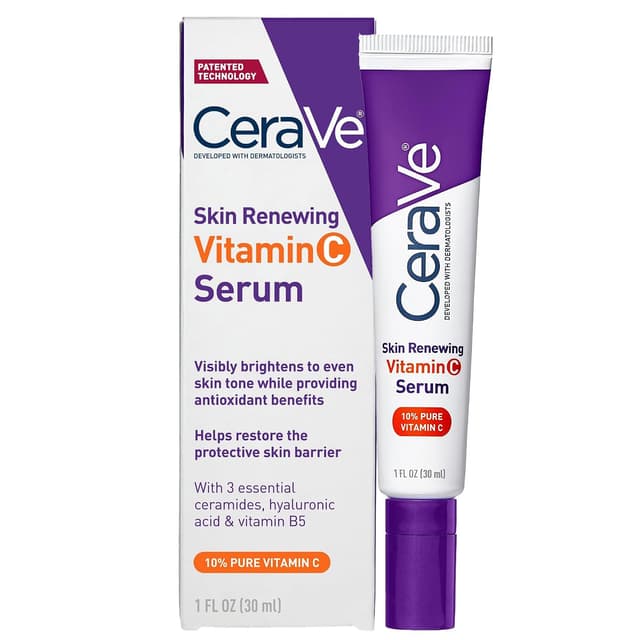
CeraVe Skin Renewing Vitamin C Serum
10% pure L-ascorbic acid with ceramides and hyaluronic acid: brightens and evens tone without stripping the barrier. Fragrance-free.
Compatibility and timing
Tranexamic acid is well tolerated overall and compatible with nearly everything. Vitamin C: yes, the mechanisms complement each other. Niacinamide: yes, the classic pairing. Retinol: yes, ideally at different times of day. AHA/BHA exfoliants: yes, alternating. If a dermatologist has prescribed hydroquinone, ask them before adding anything.
Pregnancy and breastfeeding: what we know
It's the most common question, because melasma — the "mask of pregnancy" — shows up precisely during pregnancy. The honest answer: trials on the topical form don't include pregnant women. Absorption through the skin is low, but low isn't zero, and the absence of studies isn't proof of safety. During pregnancy and breastfeeding, the rule is simple: talk to your doctor or midwife before starting. Sunscreen, on the other hand, raises no concern and remains the most effective step against the mask of pregnancy.
What about tranexamic acid pills?
You'll hear more and more about them, and the studies back their effectiveness. But it's a medication, used for melasma outside its original indication, with serious contraindications — a history of blood clots in particular. It's a conversation to have with a dermatologist, not something to buy online.
How long before you see results
Allow eight to twelve weeks of regular use before visible fading — that's the length of the clinical trials, not a hedge. If nothing moves after sixteen weeks, the spot probably isn't the kind tranexamic acid treats: an old post-inflammatory mark or deep pigmentation is a matter for a dermatologist, sometimes a laser.
Tranexamic acid is neither a miracle nor a fad: it's a serious, well-documented active that beats most alternatives on stubborn spots, as long as it comes with daily SPF and patience. Start with a simple formula, give it three months, and judge from photos rather than the mirror.