Autumn Hair Shedding: What Works and What's a Waste
Every September the brush fills up and the panic sets in. Here's what's actually happening, and why most anti-hair-loss products can't do anything about it.
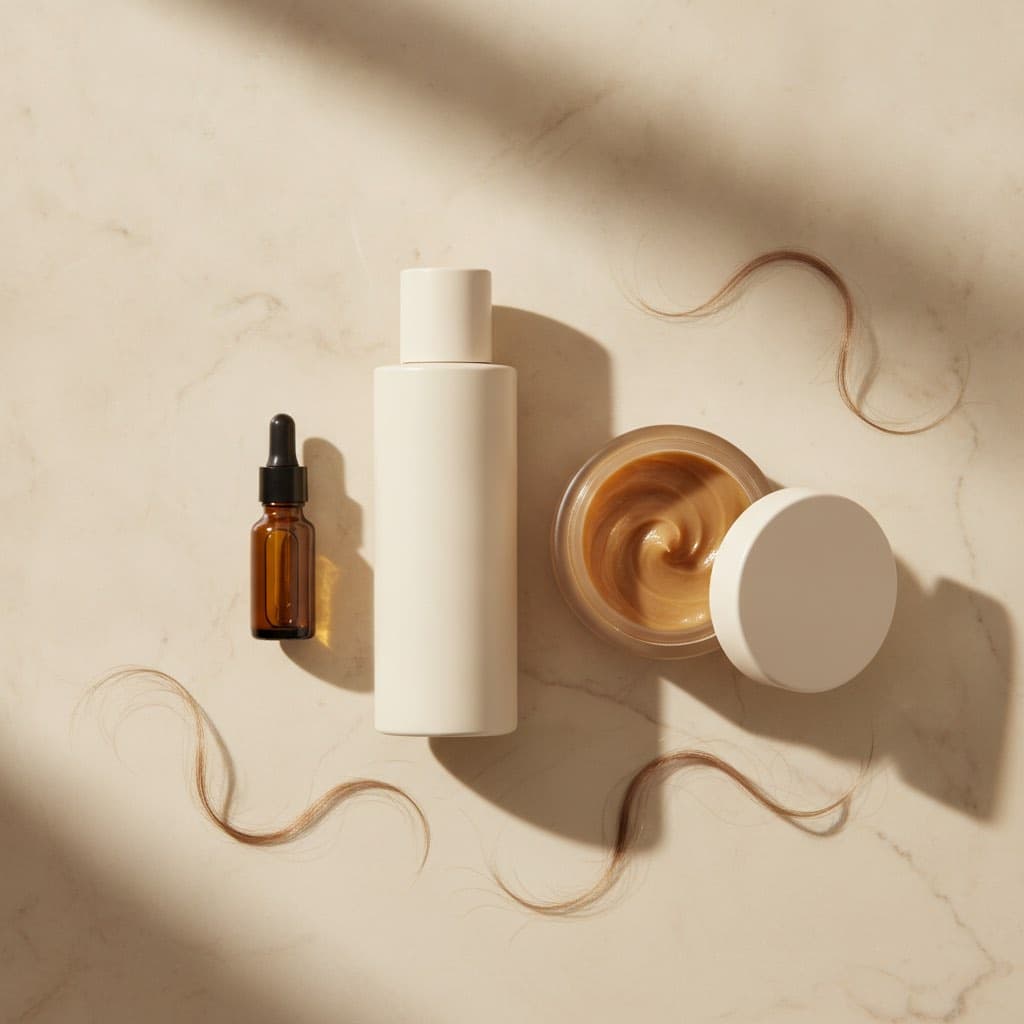
There's a moment around mid-September when the amount of hair in your brush becomes alarming. The experience is so common it has a name: seasonal telogen effluvium. And the first useful thing to know is that it's normal.
Why it happens in autumn
Hair grows in cycles. A growth phase lasting years, a resting phase, then shedding — and a new hair grows back in the same follicle. Normally these cycles are desynchronised: you lose fifty to a hundred hairs a day without noticing.
Summer synchronises part of your scalp. Sun exposure, heat and shifting daylight push a batch of hairs into the resting phase at the same time. They then shed together, with a two to three month lag. Hence the September–October peak, when you can reach a hundred and fifty a day.
“Seasonal shedding resolves on its own in six to eight weeks. The real risk isn't the shedding, it's panicking and burning money on products that can't change it.”
What no product can do
Let's be clear: no shampoo stops seasonal shedding. The hair falling in September finished its cycle in June; at that point nothing applied to the scalp will hold it. Anti-hair-loss formulas act, when they act, on the follicle environment and future density — not on what's already committed.
That's why results are judged over three months, as a course, and never on how much hair is in tomorrow's shower.
And if shedding runs past three months, comes with visible thinning patches or a widening part, it isn't seasonal any more: that's a medical workup, not a pharmacy aisle. Iron deficiency and thyroid issues are correctable, but not with shampoo.
The three products, and what they actually do
L'Oréal Elsève Total Repair 5 is the one I'd start with, and not because it's cheapest. During a shedding phase the visible problem isn't only lost volume: it's the breakage stacked on top, on lengths weakened by summer. A repair mask used once a week works on the part of the problem you can actually treat.
Vichy Dercos Aminexil is the only one designed specifically for shedding. It earns its place as a three-month course, not a panic purchase — and with measured expectations: supporting regrowth, not stopping the flow.
Kérastase Première Filler sits in another price bracket, and only justifies itself if your lengths are genuinely damaged — repeated colouring, heat, bleach. On hair that's merely summer-tired, the Elsève does comparable work for a fifth of the price.
The single most effective change costs nothing: stop brushing your hair while it's wet. That's when the fibre is weakest, and a good share of what you're reading as shedding is actually breakage. And if shedding settles in, it often starts at the root: our scalp care routine begins there.