Hair Brushes: Why One Brush for Everything Is a Bad Idea
They cost about the same and look alike on the shelf. They don't do the same job — and that gap is where the breakage happens.
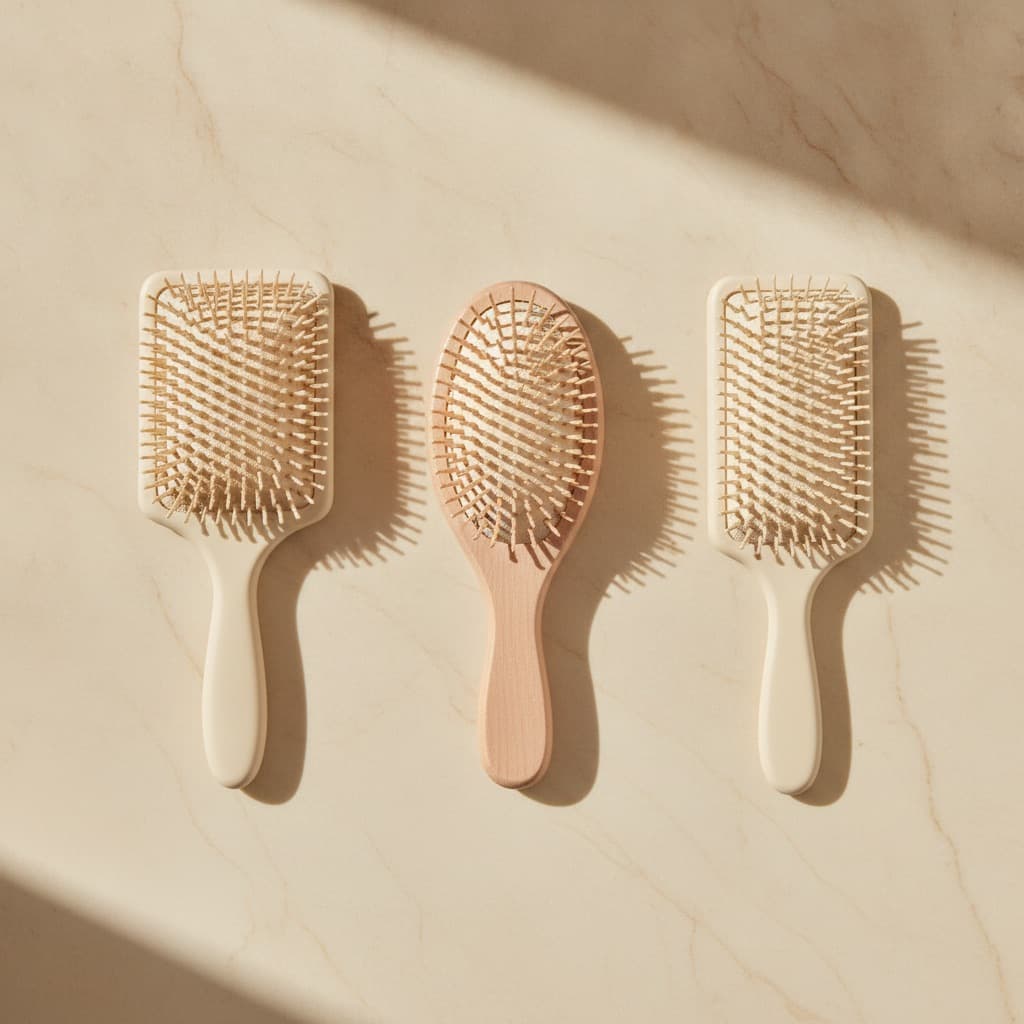
The hairbrush is the bathroom object people replace least often and choose most carelessly. You buy one, you use it for everything — detangling out of the shower, smoothing in the morning, taming at night — and you blame the resulting breakage on damaged hair. More often than not, the tool is the problem.
Three brushes, three jobs
Wet hair is the delicate case. Saturated with water, the strand swells and loses much of its elasticity: this is the moment it breaks most easily. A brush designed for dry hair, with stiff bristles set close together, pulls at the knot rather than working around it.
Wet Brush Original Detangler exists for that exact moment. Its flexible bristles bend on contact with a knot and pass through it instead of tearing it out — that's the whole principle, and it's why the name is what it is. It's the one Caroline uses, and the only one of the three I'd put through soaking hair.
Tangle Teezer Original does the same job in a different format: no handle, a palm grip, which makes it far easier to manage in the shower while conditioner sits. Its two bristle heights detangle and smooth the cuticle in a single pass. On fine dry hair it's excellent; on very thick hair the handle-free shape asks more of your wrist.
Denman D3 is not a detangling brush, and that's the most common misunderstanding about it. It's a styling brush: seven rows of pins set in a rubber cushion create the tension needed to form a curl or smooth a section while drying. Run through dry curls with no styling intent, it breaks up the curl pattern and gives you frizzy volume instead.
“A brush isn't judged on what it detangles, but on the state of the hair when you use it. The same tool is excellent at one stage and destructive at another.”
What actually matters when you buy one
Bristle flex, above everything. It's the only parameter that genuinely protects, and it takes three seconds to test in a shop: press your palm into the bristles. If they bend well and spring back, the brush will forgive a rushed morning. If they resist, they transmit every bit of that pull straight to your hair.
Tips next. Rounded bristle ends glide over the scalp; bluntly cut ones scratch it. It's invisible to the eye and very noticeable in use, especially if you brush vigorously.
Everything else — boar bristle, ionic claims, ergonomic handles — is comfort or marketing depending on the model, and never hair protection.
The habit that cancels out a good brush
Start at the ends. Always. Brushing from the roots down packs knots into each other until they form a plug you end up ripping through. Starting at the ends and working up in four-inch sections lets each knot release on its own, and even a mediocre brush becomes acceptable.
And on wet hair, squeeze before you brush. A towel pressed — not rubbed — removes the water that weighs the section down and doubles the drag. It takes thirty seconds, and it's probably the single habit that saves the most length over a year. If your lengths come out of summer damaged, a brush won't be enough: see our 3 summer hair routines based on the damage. Once your hair is detangled, a drop of the right hair serum for your hair type finishes the job.